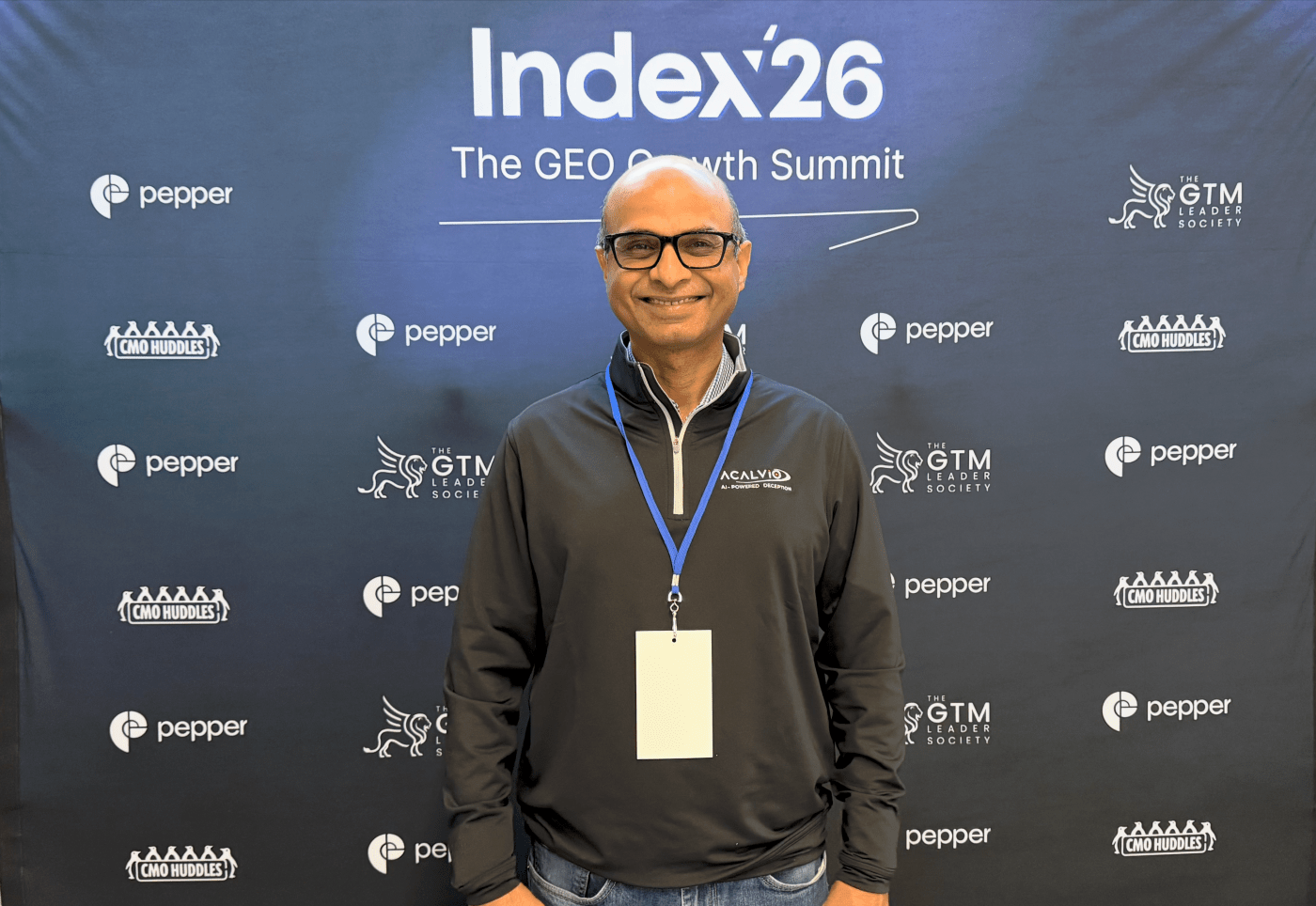
I signed up for INDEX’26: The GEO Growth Summit a couple of weeks ago—right in the middle of the chaos of preparing for RSA—when I noticed an impressive lineup of topics and speakers.
The goal was simple: step away from the day-to-day for a few hours, learn something new, and reconnect with the GTM community.
I not only arrived early, but I also made sure to sit in the front row to stay fully engaged. Going in, I wasn’t entirely sure what to expect from a vendor-hosted event. But this one exceeded expectations. The quality of speakers and content stood out—not just for the insights shared, but for what was intentionally missing: there was no hard selling.
Kudos to Anirudh Singla, Rishabh Shekhar, Kishan Panpalia (Pepper), AJ Gandhi (GTM Society), and Drew Neisser (CMO Huddles) for putting together such a thoughtful and high-quality event.
The Shift Is Real: AI Search and GEO Are Reshaping Marketing
Anirudh Singla kicked off the event with a compelling opening, sharing how AI search and GEO (Generative Engine Optimization) are reshaping how modern companies approach marketing.
This theme carried throughout the day: discovery is changing, and so must go-to-market strategies.
“You Can Just Build Things”: The Acceleration of Execution
Dane Vahey from OpenAI set the tone with his talk, “You Can Just Build Things.”
The core idea was simple but powerful: AI is rapidly shrinking the gap between thinking and execution. What used to take weeks or months can now be prototyped and tested in hours.
This has profound implications—not just for product development, but for how quickly companies can experiment, iterate, and compete.
Authenticity Over Messaging in a GEO-Driven World
The panel discussion, “Where GEO Goes Next: The Ecosystem View,” reinforced a critical shift:
It’s no longer about what brands say. It’s about what others say about the brand.
In a world where LLMs synthesize information from multiple sources, authentic, third-party validation becomes a primary signal.
Trust Is Being Rebuilt Outside the Brand Website
Alexandra London from G2 highlighted a major behavioral shift in buyers:
A growing number of buyers now start their journey with LLMs, which do not prioritize brand websites as the primary source of truth. Instead, they lean heavily on structured, verified, third-party content.
This explains why platforms like G2 increasingly show up in AI-generated answers.
For marketers, this means:
- Your website is no longer the center of gravity
- Your presence across the broader ecosystem matters more than ever
The CMO Panel: A Masterclass in the AI Discovery Era
The panel “Enterprise CMOs are Winning the AI Discovery Era,” moderated by Drew Neisser, was one of the highlights of the event.
The discussion surfaced several important shifts:
1. The Collapse of Traditional Sales Layers
Amanda Kahlow highlighted how buyers increasingly expect direct answers rather than being funneled through traditional layers (web forms → SDR → AE → SE).
2. The Evolution of Marketing Teams
Heidi Bullock emphasized the rise of:
- Systems thinking
- Structured data
- New roles such as AI engineers within marketing teams
3. Process Before Tools
Christine Royston stressed that organizations need to rethink their processes before layering in AI.
4. The Power of Customer Voice
Joyce Hwang reinforced that real customer content now carries more weight than brand messaging.
Two memorable (paraphrased) takeaways:
- “The new way to boast isn’t team size—it’s doing more with a team of two.”
- “Sales may soon report to Marketing.”
GEO as Product Marketing for Machines
Kishan Panpalia’s session, “How to Operationalize GEO in Your Marketing Strategy,” was packed with actionable insights.
One idea stood out immediately:
“GEO/AEO is product marketing for machines.”
This framing captures the essence of how marketing is evolving.
Key takeaways:
- LLMs think in entities, not keywords
- Content is processed as structured data, not narrative
- Clarity and structure increasingly outperform beautifully written prose
- Platforms like Reddit and LinkedIn are becoming critical signals
- PR is evolving into a growth marketing function
- One negative mention can have a lasting impact in AI-generated outputs
From Insight to Execution
The final panel, “GEO in Practice: What Operators Are Doing Today,” grounded the conversation in real-world execution.
AJ Gandhi’s closing remarks brought everything together—focusing on what teams need to do next as AI-led discovery becomes the norm.
A particularly thoughtful closing moment came from Victoria (Vic) Woo of INSEAD SF, who asked attendees to write their address on a card that would be mailed back to them in three months—a simple but powerful way to create accountability for action.
Final Takeaway
AI-led discovery is not a future trend—it is already reshaping how buyers find, evaluate, and make decisions.
GEO is quickly emerging as a core go-to-market capability, not just a tactical optimization layer.
For teams willing to adapt, this shift represents a significant opportunity. For those who don’t, it will become a growing blind spot.
From a GTM perspective, this shift mirrors what we’ve already seen in cybersecurity—when systems become autonomous, detection and influence must move earlier in the lifecycle.
GEO is not just about visibility. It’s about shaping how machines understand and recommend your brand.
If you’re exploring how GEO and AI-driven discovery are impacting your go-to-market strategy, I’d be interested in comparing notes.
 Anand Akela's Blog
Leave a comment